
Article by: Anne Li of the Arkansas Democrat Gazette
Photo by: Adam Vogler of the Arkansas Democrat Gazette
Silence falls as Jack Liu shifts behind the lectern. Then: an explosion of sound.
"The first contention is inherency: The Arctic is the soft underbelly of international American military operations. Status quo under-investment in logistics threatens --" sharp breath "-- to embolden foreign adversaries..."
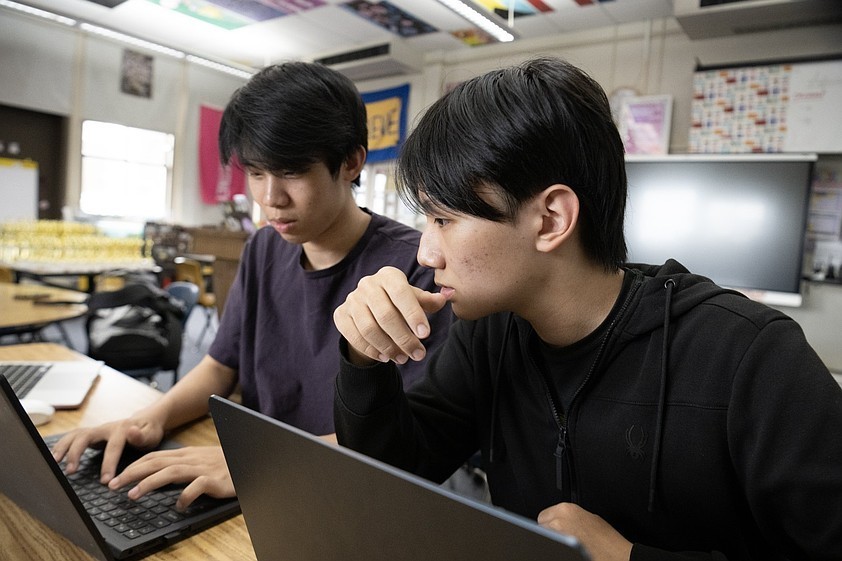
On a Wednesday morning, Liu and his debate partner, Shangyu Wu, sparred with their fellow Little Rock Central High School debaters in Rosie Valdez Block's fourth-floor classroom. The two juniors have spent the last 10 months conducting what Valdez Block, Central's speech and debate director, called the equivalent of dissertation-level research into Arctic policy.
That effort has paid off. In a field crowded with teams from some of the most elite high schools in the U.S., Liu and Wu are among the crème de la crème.
In February, the duo emerged winners of the Harvard National Speech and Debate Tournament, which convened more than 100 policy debate teams from around the country. Liu and Wu's win was a first in state history and came after a two-and-a-half day run of undefeated matches.
This week, they'll head to Kentucky for the J.W. Patterson Tournament of Champions -- what Valdez Block called the Run for the Roses of high school debate.
Back at Central, Liu wraps up his five-minute monologue delivered at breakneck speed. Fellow Central debater Aarush Gaddi, seated to Liu's right, launches into cross-examination, followed by his own monologue, followed by a motion to bow out.
"I'd like to phone a friend," Gaddi jokes. "I have a stat test."
The students, who put on the simulation debate at the request of a reporter, trade lighthearted barbs. "Y'all are so unserious," Valdez Block mutters.
Central debaters spend a class period every other day, and many afternoons, in Valdez Block's classroom, where she also teaches debate and forensics classes. Students must be enrolled in a communication class to compete, though not all students in the classes are on the team. Many are simply looking for a communication credit, a graduation requirement, though some end up taking it multiple years just for fun.
The classroom decor, like the simulation debate, is a clue to the team's character: fiercely competitive, quick to laugh. Trophies overflow on every shelf; one-liners like "Raise Hell, Kid" and "#FreeBritney" blare from posters. The team T-shirt, hot pink on black, features a crowned tiger and a Chappell Roan-inspired tagline: "Your favorite team's favorite team."
Liu and Wu began debating in ninth grade and teamed up in 10th. (Policy debaters compete in pairs.) Liu knew he wanted to do it competitively; Wu was just trying it out. Over the years they've honed the skills needed to succeed: everything from digging through complex documents and anticipating their opponents' arguments to thinking on the fly and speaking hundreds of words per minute.
The two spent last summer at debate camp, gathering material for the year ahead based on a resolution set by the National Speech and Debate Association, the foremost speech and debate organization in the U.S. This year's resolution is: "The United States federal government should significantly increase its exploration and/or development of the Arctic."
Liu and Wu's objective: to be able to argue "yes" or "no" at the drop of a hat.
Their soft-spokenness in an interview belies their competitive streak. Valdez Block describes Wu as a careful communicator who turns into someone else entirely when he debates. Liu, who's more "bombastic," tones it down on the floor, Valdez Block said.
"He slow-plays people strategically in debates, and he reels them in, makes them feel safe to answer certain questions," she said. "And then the torpedo is in the water."
Little Rock has long been home to a tight-knit speech and debate community. Valdez Block's mother coached debate in Little Rock schools for more than four decades. Valdez Block, now 38, watched debate rounds before she could read: "I knew that I really wanted to do it someday, when I was old enough."
As a Parkview High School debater, she was coached by her mother's college debate partner, and her debate partner at Parkview, Colton Gilbert, is now her assistant coach at Central.
Central's debate program dates back to the '70s but began generating buzz on the national circuit starting around the mid-2000s, according to Valdez Block. "There would be one or two teams," she said, "that would really be scrappy on the national circuit, and have to fight for it really hard, but would be really successful" at branching out-of-state.
When Valdez Block began coaching at Central in 2012, she wanted to elevate the program's national presence, to give students more opportunities to compete and travel. She flew on a plane for the first time as part of a debate trip in high school, an experience she strives to -- and does -- pass on to her students now.
In an expensive activity traditionally dominated by white men, Valdez Block said, Central's program is special because its demographic reflects that of the school. "We read arguments that are different from a lot of the community," Valdez Block said. "We read a lot of arguments about subjectivity and about our experiences, not just about policy."
"We're still scrappy in the sense that we are the only Title I urban public school that's ranked in the top 10 debate programs in the country," she added. "But we are not scrappy, and haven't been for about a decade, in terms of the seriousness that people approach competing against us."
Central Speech and Debate raises money by hosting a tournament every fall for nearly 1,000 competitors around the state and crowdfunds at least once a year. "We are constantly hustling," Valdez Block said: Of the $132,000 it costs the team to run its season start to finish, the team fundraises around $89,000.
The team often travels in Valdez Block and her husband's personal vehicles and sleeps "like sardines" in hotels, she said. The staff covers many of the expenses that would otherwise fall on students. Valdez Block is determined to run a program in which "financial hardship will never be a reason that you don't get to participate."
Central alums who were transformed by debate, including those from low-income backgrounds, are among the most generous donors, she said, often reaching out to "ask how they can help our current kids."
Debate has taught her students to think critically and evaluate every source's validity, important in an era of disinformation and overreliance on artificial intelligence, Valdez Block said.
She's watched debate transform her students beyond the classroom too: They know they have something valuable to say, and they trust in their convictions.
"We have a saying in debate," Valdez Block said. "'You might not be interested in politics, but politics is very interested in you.'" Through debate, she added, Liu and Wu have flourished into "very competent advocates for themselves and others."
Wu felt great pride winning at Harvard as a representative of an urban public school from Arkansas, he said. Liu mostly felt relief: "We were debating the whole day, and I was really hungry."
The two are gearing up for the Tournament of Champions in the manner of sports stars. They're doing speaking drills and stamina training and focusing on nutrition and hydration, Valdez Block said.
In keeping with debate tradition, they'll cut out dairy to curb mucus production (which "might be a little superstition," Valdez Block admitted, "because I think there's not really science behind it"), and they're supposed to follow a strict sleep schedule ("Whether or not they do it, I don't know").
Stepping into the intellectual ring of a debate round is terrifying every time, Valdez Block said. It means putting "what you know and what you don't know on the line." As juniors, though, Liu and Wu have one more year of competition ahead of them. That makes their wins all the more noteworthy, Valdez Block said, and takes some of the pressure off.
The two are heirs to a distinguished legacy, Valdez Block said. Central last had a team "at this stature" in 2016, she said, when DJ Williams and Payton Woods finished second at that year's Tournament of Champions. The "Williams and Woods" duo is still legendary among Central debaters.
On this 10-year anniversary, she said, "We're definitely carrying that energy with us."